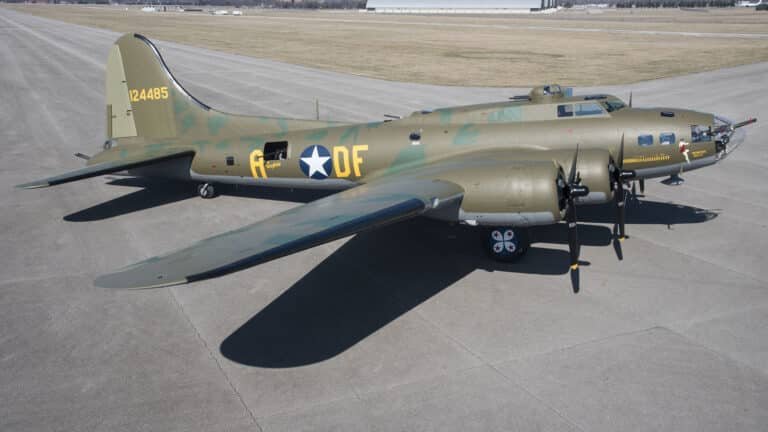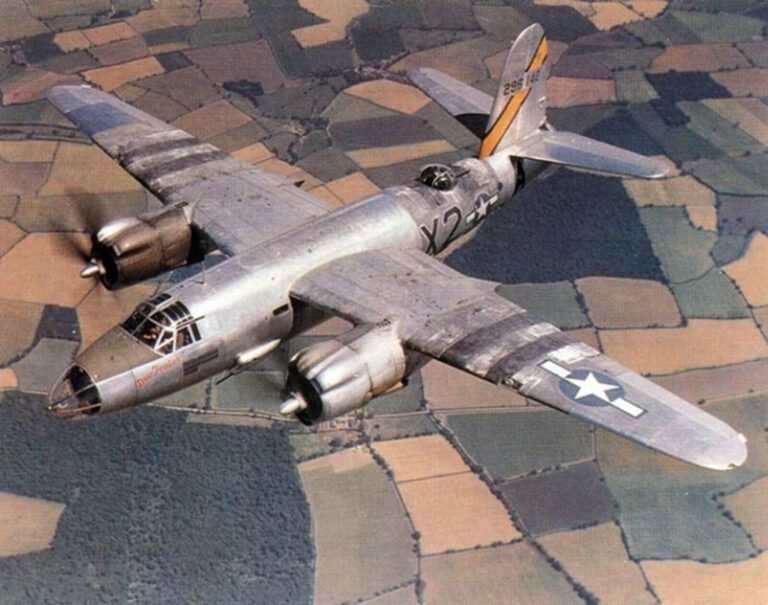
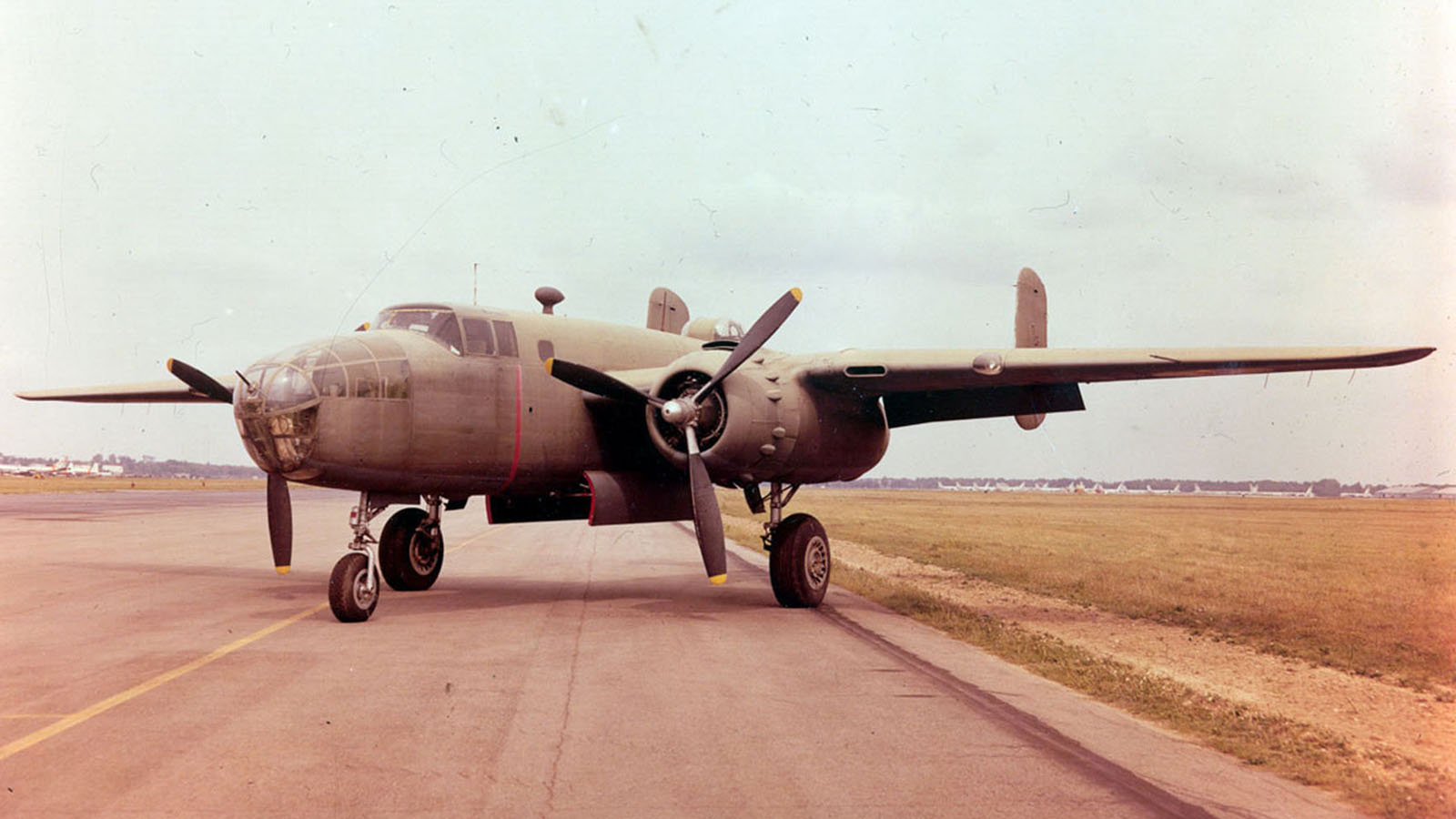
B-25B Mitchell
In WWII aviation, there’s no plane quite like the B-25B Mitchell. It’s the powerhouse that changed the game. With its innovative design and impressive operational history, it’s not just a piece of history—it’s a flying testament to human ingenuity. This article delves into the origins, notable missions, and technical features of the B-25B Mitchell, revealing its enduring legacy and impact. Buckle up, it’s going to be an exciting flight through history.
B-25B Mitchell: Origin and Design
The B-25B Mitchell’s design and inception, a noteworthy period in aviation history, began in the late 1930s as America was gearing up for potential involvement in World War II. North American Aviation, a leading aerospace manufacturer, was challenged to develop a medium bomber to outperform existing models. They didn’t disappoint; by August 1940, the first B-25 had taken to the skies.
This aircraft was unique. It boasted a twin-engine design, offering increased power and reliability. It could carry a substantial payload and had an impressive range, making it ideal for various missions. The B-25B was also equipped with a notable innovation: a specifically designed bombsight for precision targeting, a technology that revolutionized aerial warfare.
However, it wasn’t just the technical prowess that made the B-25B stand out. It was the aircraft’s adaptability. It proved helpful in diverse environments, from the Pacific Islands to the deserts of North Africa. It was this versatility that solidified the B-25B’s place in history.
In short, the B-25B Mitchell was a testament to American ingenuity and a significant contribution to the successful Allied efforts in World War II.
Operational History in WWII
While the B-25B Mitchell’s design was impressive during World War, it truly made its mark, serving in nearly every theater of the war and playing a crucial role in critical battles.
From the Pacific to Europe, the B-25 Mitchell’s versatility proved invaluable.
In the Pacific, it’s famous for the Doolittle Raid, where 16 B-25Bs launched from an aircraft carrier, a feat thought impossible, gave America its first military victory after Pearl Harbor. The raid’s success bolstered American spirits and proved Mitchell’s adaptability.
In the European theater, the Mitchell served with distinction in the Mediterranean and North Africa, providing close air support and strategic bombing. In these battles, the Mitchell’s resilience and firepower truly shone.
The Mitchell fought against the fearsome Japanese air force in the China-Burma-India theater, showing its mettle in some of the harshest conditions.
The B-25B Mitchell’s operational history in WWII isn’t just about battles won or lost. It’s about the plane’s adaptability, resilience, and significant contribution to the war effort, proving that it was more than an impressive design. It was a warbird that genuinely made a difference.
Notable Missions and Achievements
Distinguishing itself in numerous vital missions, the B-25B Mitchell amassed a significant list of accomplishments during its service in World War II.
Most notably, the B-25B’s role in the Doolittle Raid in April 1942 marked it as an aircraft of significance. This daring mission involved launching 16 B-25Bs from an aircraft carrier to bomb Tokyo, demonstrating that mainland Japan was within reach of American bombers and boosting US morale.
Another highlight was its contribution to the North African Campaign. The B-25B’s exceptional low-altitude bombing and strafing capabilities were instrumental in disrupting Axis supply lines and military operations.
In the Pacific Theater, B-25Bs were heavily used in the Solomon Islands and New Guinea campaigns. Equipped with nose-mounted machine guns, they excelled in strafing and skip bombing attacks against Japanese shipping.
The B-25B’s adaptability also shone in the Aleutian Islands Campaign, where it weathered extreme conditions to neutralize Japanese holds.
Despite facing rugged conditions and formidable enemies, the B-25B Mitchell’s versatility, durability, and firepower earned it a place in history as a highly successful medium bomber of WWII.
These missions underscore the B-25B’s invaluable contributions to the Allied victory.
Technical Specifications and Features
Drawing directly from its success in combat, it’s clear that the B-25B Mitchell’s technical specifications and features played a pivotal role in its effectiveness and adaptability across various mission types. This twin-engine bomber boasted a top speed of 272 mph, a range of 1,350 miles, and a service ceiling of 24,200 feet. Its robust structure, coupled with a wingspan of 67 ft 7 in, allowed it to withstand harsh flight conditions.
The B-25B Mitchell was armed to the teeth. It housed three .50 cal machine guns in a turret at the nose and an additional dorsal turret with a pair of .50 cal guns. The bomb bay was designed to carry a 3,000-pound bomb load, providing it with substantial firepower.
It’s also noteworthy that the aircraft had a crew capacity of six: pilot, co-pilot, navigator/bombardier, turret gunner/engineer, radio operator/waist gunner, and tail gunner. Its advanced radio and navigation systems, including autopilot, enhanced its operational efficiency.
The B-25B Mitchell’s technical prowess and unique features made it a formidable force during WWII, solidifying its place in military aviation history.
B-25B Mitchell’s Legacy and Impact
Through its technical prowess, the B-25B Mitchell left an indelible impact on military aviation, shaping the strategies and designs of subsequent warplanes. Its innovative design and functionalities became a blueprint for future aircraft, underscoring the importance of versatility and firepower in combat situations.
The B-25B Mitchell’s influence can be seen in developing multirole combat aircraft, which combine the capabilities of bombers and fighters. It’s not just its design that’s had a lasting impact; the B-25B Mitchell’s successful use in the Doolittle Raid during World War II demonstrated the effectiveness of medium bombers in strategic operations—this pivotal moment in history led military strategists to reconsider the role of such aircraft, influencing later war tactics.
Regarding cultural impact, the B-25B Mitchell has become a symbol of American ingenuity and resilience. It’s been immortalized in various forms of media, from films to historical literature, cementing its place in the public consciousness.
Frequently Asked Questions
What Is the Current Status of B-25b Mitchell Aircraft?
Inquiring about the status and location of any remaining objects, he’s learned that several are preserved in museums worldwide. They’re primarily in static display, a testament to their historical significance in aviation.
Have Any Movies or TV Shows Featured the B-25b Mitchell?
Yes, there’ve been instances where it’s featured prominently. Notably, in ‘Catch-22’, a classic film and recent TV series, it’s used extensively, showcasing its unique design and historical significance in a dramatic narrative.
What Were the Training Procedures for the B-25b Mitchell?
During WWII, pilots underwent rigorous training procedures. They’d start with classroom instructions and then advance to simulator training. Finally, they’d take on actual flight training, focusing on navigation, bombing accuracy, and emergency procedures.
Were Any Notable Pilots or Crew Members Associated With the B-25b Mitchell?
“Yes, there were notable individuals. Most famously, Lieutenant Colonel James Doolittle led the Doolittle Raid on Tokyo during WWII, a daring mission that significantly boosted American morale. He’s renowned for piloting this particular aircraft.”
How Does the B-25b Mitchell Compare to Other Bomber Aircraft?
Compared to its contemporaries, it’s noteworthy for its exceptional performance and reliability. Its speed, maneuverability, and bombing accuracy made it stand out, while its robust design ensured dependable operation under various conditions.
Conclusion
The B-25B Mitchell, with its remarkable design and impressive operational history in WWII, has left a significant legacy. Its notable missions underscore the aircraft’s vital role in warfare, and its technical specifications highlight its superior capabilities.
The B-25B Mitchell shaped WWII’s outcome and revolutionized aviation technology, leaving an indelible impact on military history. Its story is a testament to human ingenuity and resilience in conflict.