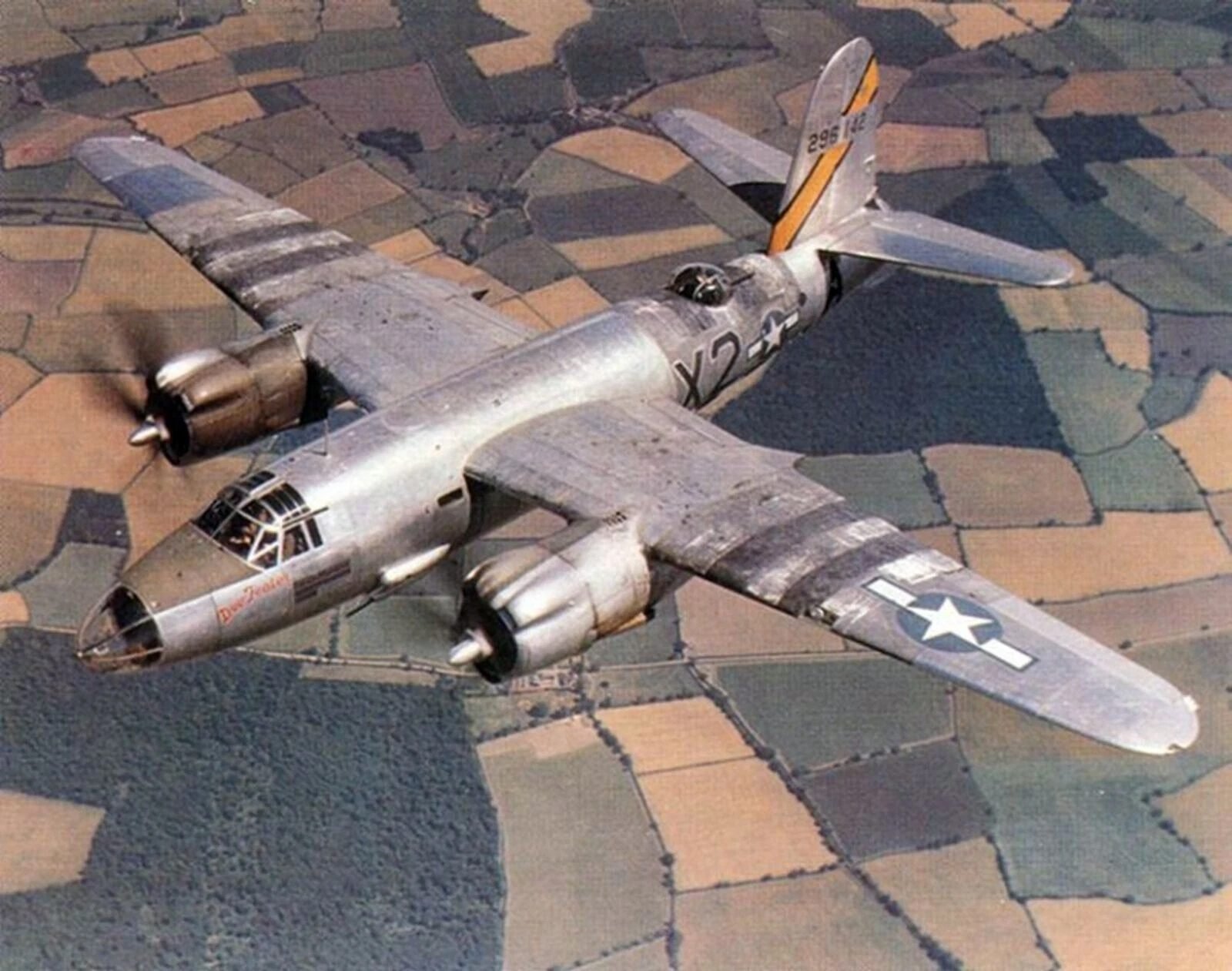
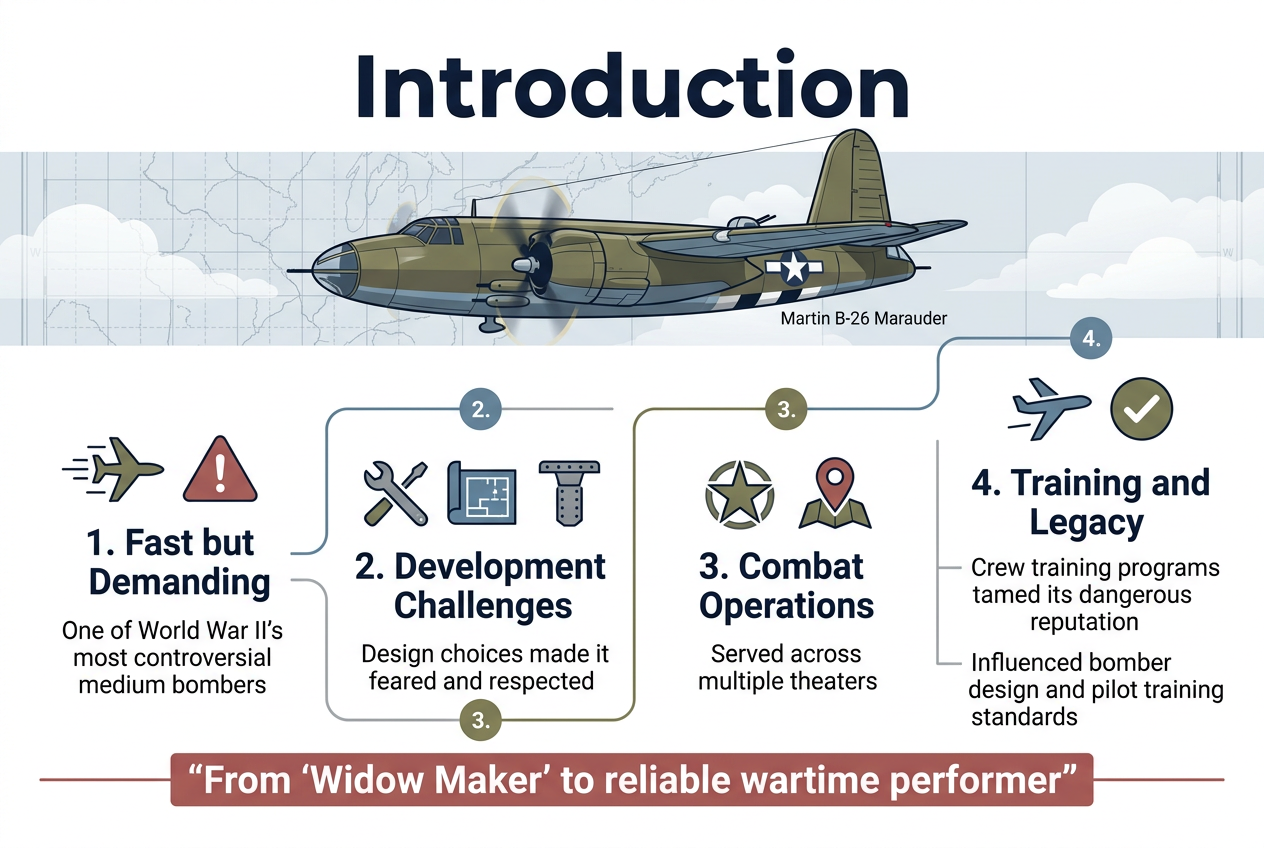
The Martin B-26 Marauder earned a reputation as one of World War II’s most controversial medium bombers. Aviation enthusiasts, history buffs, and military aircraft researchers will discover how this fast but demanding aircraft transformed from “Widow Maker” to a reliable wartime performer.
This deep dive covers the Marauder’s development challenges and design choices that made it both feared and respected. You’ll learn about its combat operations across multiple theaters and how extensive crew training programs eventually tamed its dangerous reputation. We’ll also explore the aircraft’s lasting influence on bomber design and pilot training standards.
Development History and Design Philosophy
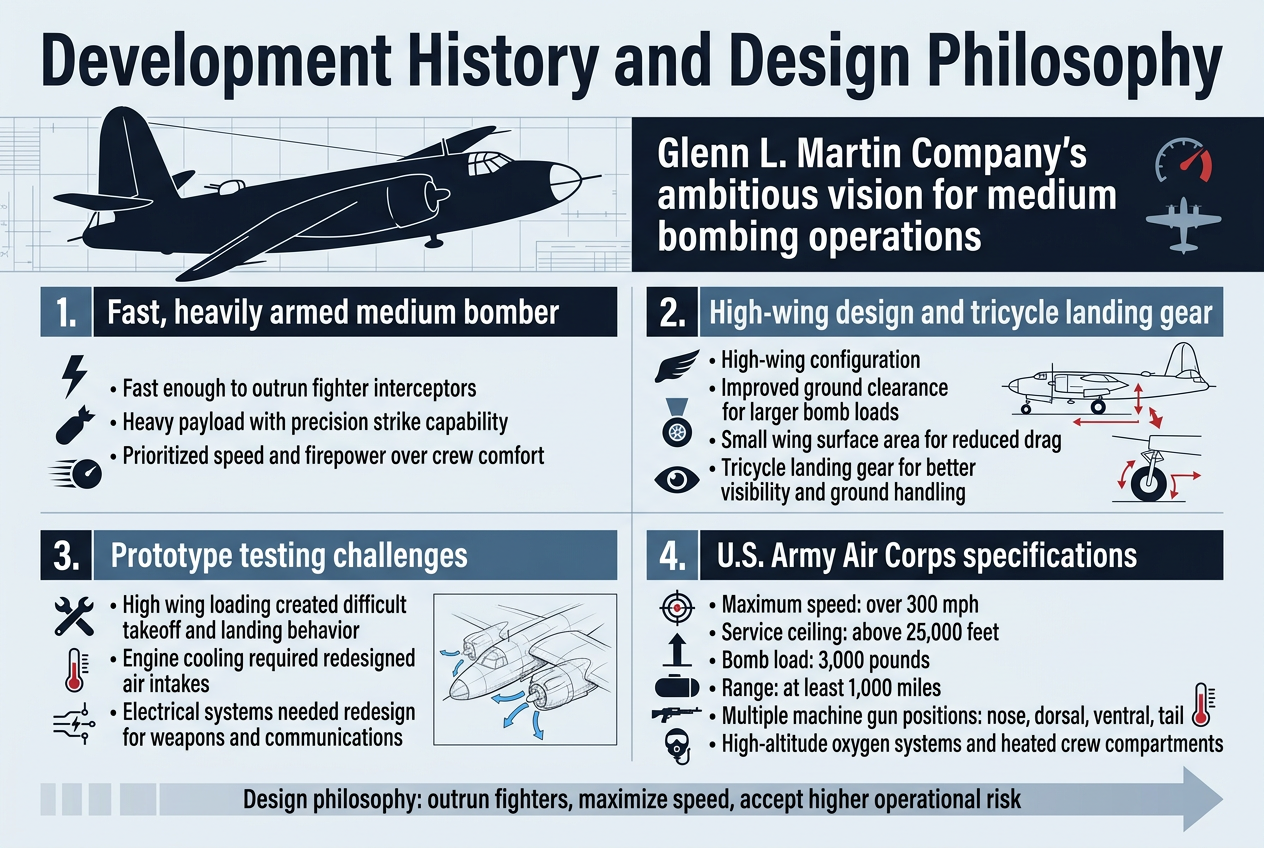
Glenn L. Martin Company’s ambitious vision for medium bombing operations
Glenn L. Martin Company entered the 1930s with bold aspirations to revolutionize military aviation. The company recognized a critical gap in the U.S. Army Air Corps’ capabilities – the need for a fast, heavily armed medium bomber that could penetrate enemy defenses and deliver devastating payloads with precision. Martin’s engineers envisioned an aircraft that would push the boundaries of conventional design, prioritizing speed and firepower over the traditional emphasis on defensive armament and crew comfort.
The company’s leadership understood that future aerial warfare would demand bombers that could outrun fighter interceptors rather than engage them in prolonged defensive battles. This philosophy drove their commitment to building an aircraft with exceptional performance, even if it meant accepting higher operational risks and demanding superior pilot skills.
Revolutionary high-wing design with tricycle landing gear innovation
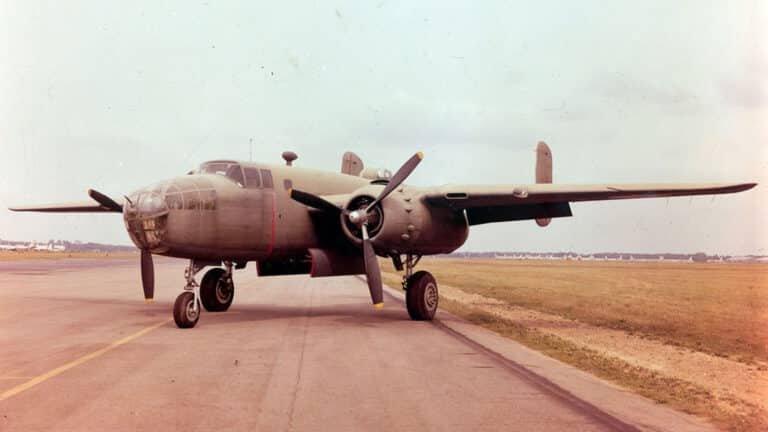
The B-26 Marauder emerged as a testament to cutting-edge aerodynamic engineering. Martin’s design team used a distinctive high-wing configuration that offered several tactical advantages, including improved ground clearance for larger bomb loads and greater stability during low-level attack runs. The wing’s relatively small surface area, while controversial, was deliberately calculated to maximize speed and reduce drag.
The tricycle landing gear represented a revolutionary departure from conventional tail-wheel configurations. This innovation gave pilots significantly improved ground handling, better forward visibility during taxiing, and a reduced risk of ground loops during landing. The nose-wheel design also eliminated the tendency of aircraft to tip forward during hard braking, a common problem with tail-wheel aircraft carrying heavy bomb loads.
Engineering challenges overcome during the prototype testing phase
Early prototype testing revealed significant aerodynamic complexities that demanded innovative solutions. The aircraft’s high wing loading created challenging flight characteristics, especially during takeoff and landing. Martin’s engineers worked tirelessly to refine the wing’s airfoil design and adjust control surface responsiveness to manage these demanding flight behaviors.
Engine cooling presented another major obstacle. The powerful Pratt & Whitney R-2800 engines generated substantial heat, requiring sophisticated cooling systems to prevent overheating during extended combat missions. Engineers redesigned air intake configurations multiple times to keep engine temperatures optimal while maintaining aerodynamic efficiency.
The aircraft’s electrical systems also underwent extensive redesigns after initial tests revealed inadequate power distribution for the complex array of defensive weapons, navigation equipment, and communication systems required for combat operations.
Military specifications that shaped the aircraft’s unique characteristics
The U.S. Army Air Corps’ demanding specifications directly influenced every aspect of the B-26’s design philosophy. Military requirements called for a maximum speed over 300 mph, a service ceiling above 25,000 feet, and the ability to carry a 3,000-pound bomb load for at least 1,000 miles. These specifications pushed Martin’s engineers to create an aircraft that operated at the absolute limits of contemporary technology.
The military’s emphasis on defensive firepower led to multiple machine-gun positions, including nose, dorsal, ventral, and tail turrets. Each weapon installation required careful weight-distribution calculations and structural reinforcements that affected the aircraft’s center of gravity and overall performance.
Range requirements demanded substantial fuel capacity, which shaped the B-26 Marauder’s wing design and internal layout. The military’s insistence on high-altitude capability drove the development of sophisticated oxygen systems and heated crew compartments for extended missions in harsh environments.
Technical Specifications and Performance Capabilities
Twin Pratt & Whitney R-2800 engine configuration delivering superior power
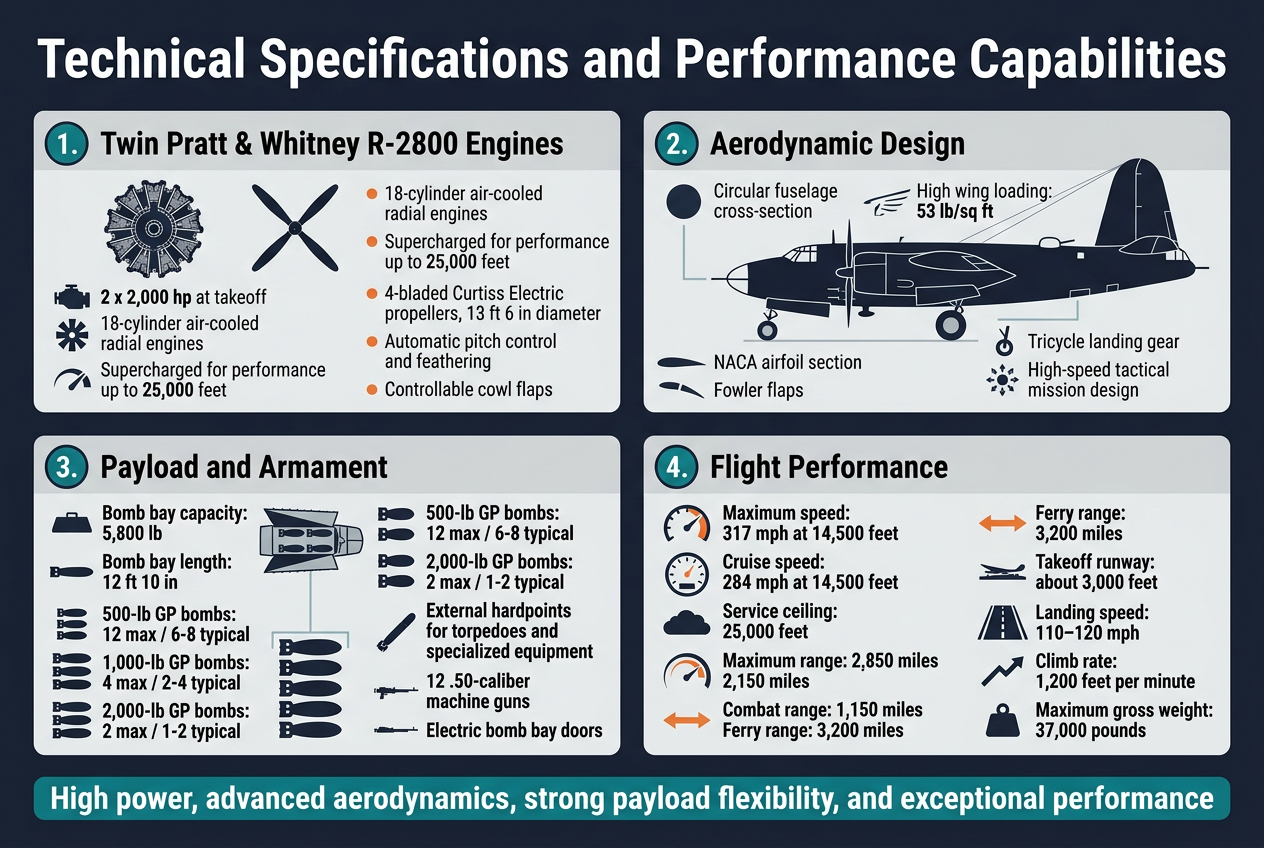
The B-26 Marauder’s powerplant consisted of two Pratt & Whitney R-2800 Double Wasp radial engines, each producing 2,000 horsepower at takeoff. These air-cooled, 18-cylinder engines represented cutting-edge technology for their time, delivering exceptional power-to-weight ratios that enabled the aircraft’s impressive performance characteristics. The R-2800 engines featured a two-row radial configuration with supercharging, allowing the Marauder to maintain strong performance at operational altitudes up to 25,000 feet.
Each engine drove a four-bladed Curtiss Electric propeller with a 13-foot-6-inch diameter. The propeller system included automatic pitch control and feathering capabilities, critical features for maintaining control during single-engine emergencies. The engine installation incorporated advanced cooling systems with controllable cowl flaps that pilots could adjust based on flight conditions and power settings.
Advanced aerodynamic features enabling high-speed tactical missions
Martin’s designers incorporated several innovative aerodynamic elements that distinguished the B-26 Marauder from contemporary medium bombers. The aircraft featured a circular fuselage cross-section that minimized drag while maximizing internal volume. The wing design used a relatively high wing loading of 53 pounds per square foot, which enabled high cruise speeds but required careful handling during takeoff and landing.
The wing’s NACA airfoil section provided excellent high-speed characteristics while maintaining structural integrity under combat loads. Fowler flaps extended along the trailing edge, increasing both wing area and camber during low-speed operations. The aircraft’s tricycle landing gear configuration was revolutionary for medium bombers of this era, improving ground handling and reducing the risk of nose-over incidents during taxi operations.
Payload capacity and bomb bay configuration for varied mission profiles
The B-26 Marauder’s internal bomb bay could accommodate up to 5,800 pounds of ordnance in its standard configuration. The bomb bay measured 12 feet 10 inches long and featured a unique tandem arrangement that allowed flexible loading options. Standard loadouts included combinations of 500-pound, 1,000-pound, and 2,000-pound general-purpose bombs, depending on mission requirements.
| Ordnance Type | Maximum Load | Typical Mission Load |
|---|---|---|
| 500-lb GP bombs | 12 bombs | 6-8 bombs |
| 1,000-lb GP bombs | 4 bombs | 2-4 bombs |
| 2,000-lb GP bombs | 2 bombs | 1-2 bombs |
| Incendiary clusters | Variable | Mission-dependent |
External hardpoints could carry additional ordnance or specialized equipment, including torpedoes for anti-shipping missions. The bomb bay doors operated electrically and could open rapidly for emergency jettison. The aircraft also carried defensive armament: twelve .50-caliber machine guns distributed across various positions.
Flight performance metrics that set new standards for medium bombers
The B-26 Marauder achieved remarkable performance figures that surpassed most contemporary medium bombers. It reached a maximum speed of 317 mph at 14,500 feet, while cruise speed averaged 284 mph at the same altitude. Its 25,000-foot service ceiling provided operational flexibility and improved survivability against enemy interceptors.
Range capabilities varied significantly based on payload and mission profile:
- Maximum range with reduced bomb load: 2,850 miles
- Combat range with full bomb load: 1,150 miles
- Ferry range with external tanks: 3,200 miles
Takeoff performance required careful attention due to the high wing loading. With a maximum gross weight of 37,000 pounds, the aircraft needed approximately 3,000 feet of runway under standard conditions. Landing speeds averaged 110-120 mph, demanding skilled piloting techniques and precise approach management. The B-26’s 1,200 feet-per-minute climb rate at sea level enabled rapid altitude gains during tactical operations. At the same time, its excellent high-altitude performance made it effective for precision bombing missions over heavily defended targets.
Combat Operations and Wartime Service Record
European Theater deployment and tactical bombing campaigns
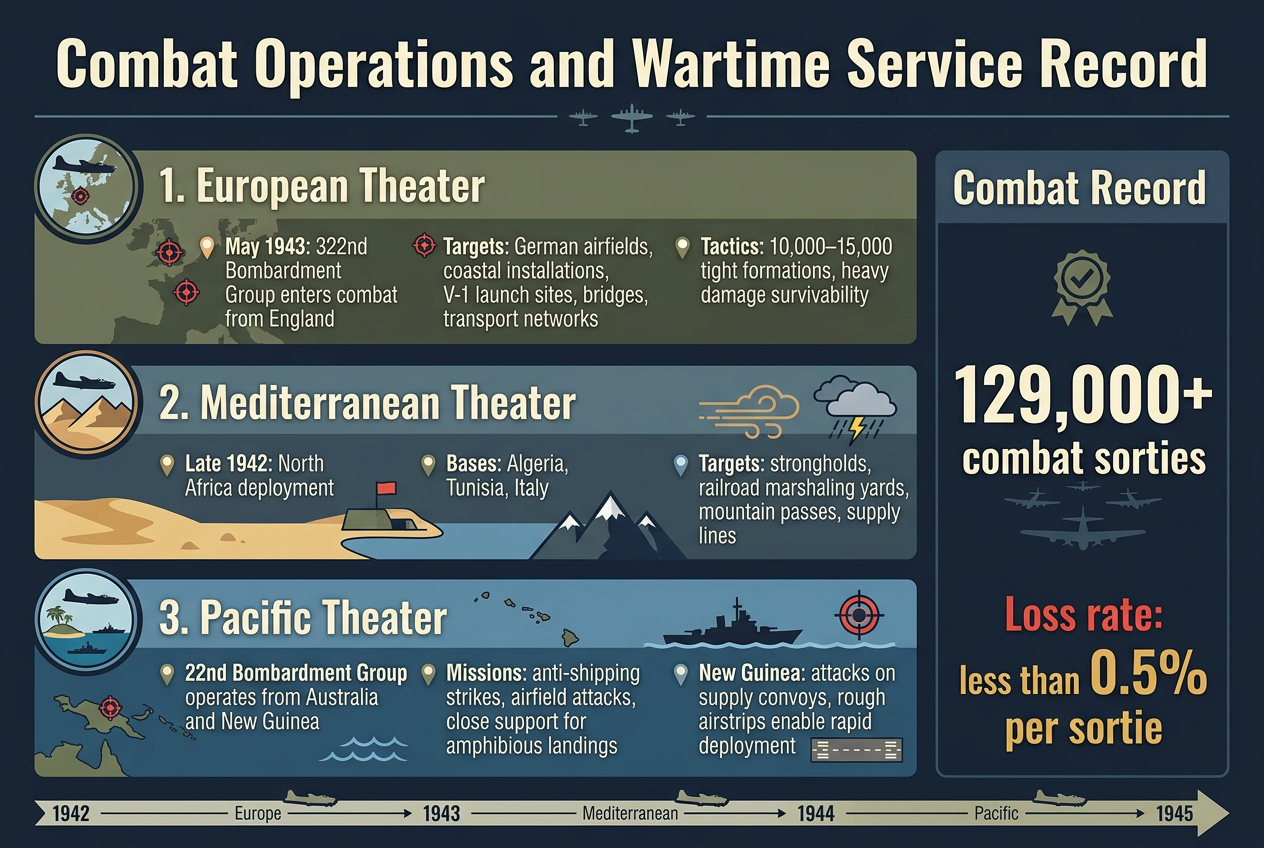
The B-26 Marauder entered European combat operations in May 1943 with the 322nd Bombardment Group, beginning what would become one of World War II’s most successful medium-bomber campaigns. Initially operating from bases in England, these aircraft faced significant challenges during their early missions over occupied Europe. The first missions targeted German airfields and coastal installations, and crews quickly learned that the Marauder’s speed and altitude made it particularly effective against heavily defended targets.
By late 1943, B-26 units had refined their tactics, typically operating at altitudes between 10,000 and 15,000 feet while maintaining tight formations for mutual defensive fire. The aircraft’s robust construction proved invaluable during these missions, as many Marauders returned to base despite sustaining heavy battle damage. Notable campaigns included the systematic destruction of V-1 flying bomb launch sites along the French coast, where B-26 squadrons flew precision strikes that significantly reduced the threat to British cities.
During the D-Day preparations and aftermath, Marauder groups conducted intensive bombing campaigns against German transportation networks, bridges, and supply depots throughout France and Belgium. These missions directly supported the Allied invasion by disrupting enemy reinforcement capabilities and cutting vital supply lines.
Mediterranean operations showcasing versatility in diverse conditions
The Mediterranean Theater provided the perfect proving ground for the B-26’s adaptability to diverse operational environments. Beginning in late 1942, Marauder units deployed to North Africa faced extreme weather, from desert sandstorms to Mediterranean winter storms, while maintaining high operational readiness.
Operating from bases in Algeria, Tunisia, and later Italy, B-26 crews developed specialized techniques for attacking heavily fortified positions and strategic targets across the region. The aircraft’s ability to carry a variety of bomb loads made it particularly effective against German and Italian strongholds in Sicily and mainland Italy. During the Italian campaign, Marauders consistently struck enemy supply lines, particularly railroad marshaling yards and mountain passes crucial to Axis defensive positions.
The B-26’s versatility became especially apparent during complex-terrain operations in the Italian mountains, where precise navigation and bombing accuracy were essential. Crews adapted their tactics to rapidly changing weather and mountainous terrain, often flying at varying altitudes to avoid enemy fighters while maintaining bombing effectiveness.
Pacific Theater contributions to Allied victory efforts
Though less well-known than their European counterparts, B-26 Marauder operations in the Pacific Theater played a crucial role in the island-hopping campaign against Japanese forces. The 22nd Bombardment Group, operating primarily from bases in Australia and New Guinea, pioneered many tactics that would later prove essential to medium-bomber operations in the Pacific.
Pacific Marauder missions differed significantly from European operations, focusing heavily on anti-shipping strikes, airfield attacks, and close support for ground forces during amphibious landings. The aircraft’s range and payload made it ideal for the long overwater flights required in the Pacific, while its defensive armament protected it against Japanese fighters.
The B-26 Marauder was particularly noteworthy during the New Guinea campaign, where it regularly attacked Japanese supply convoys and installations, effectively cutting enemy supply lines to isolated garrisons. The Marauder’s ability to operate from short, rough airstrips proved invaluable as Allied forces advanced across the Pacific, enabling rapid deployment to newly captured bases.
Throughout all theaters, the B-26 Marauder compiled an impressive combat record, with over 129,000 combat sorties flown and a remarkably low loss rate of less than 0.5% per sortie by war’s end.
Crew Training Challenges and Safety Improvements
Initial pilot training difficulties with high-speed landing characteristics
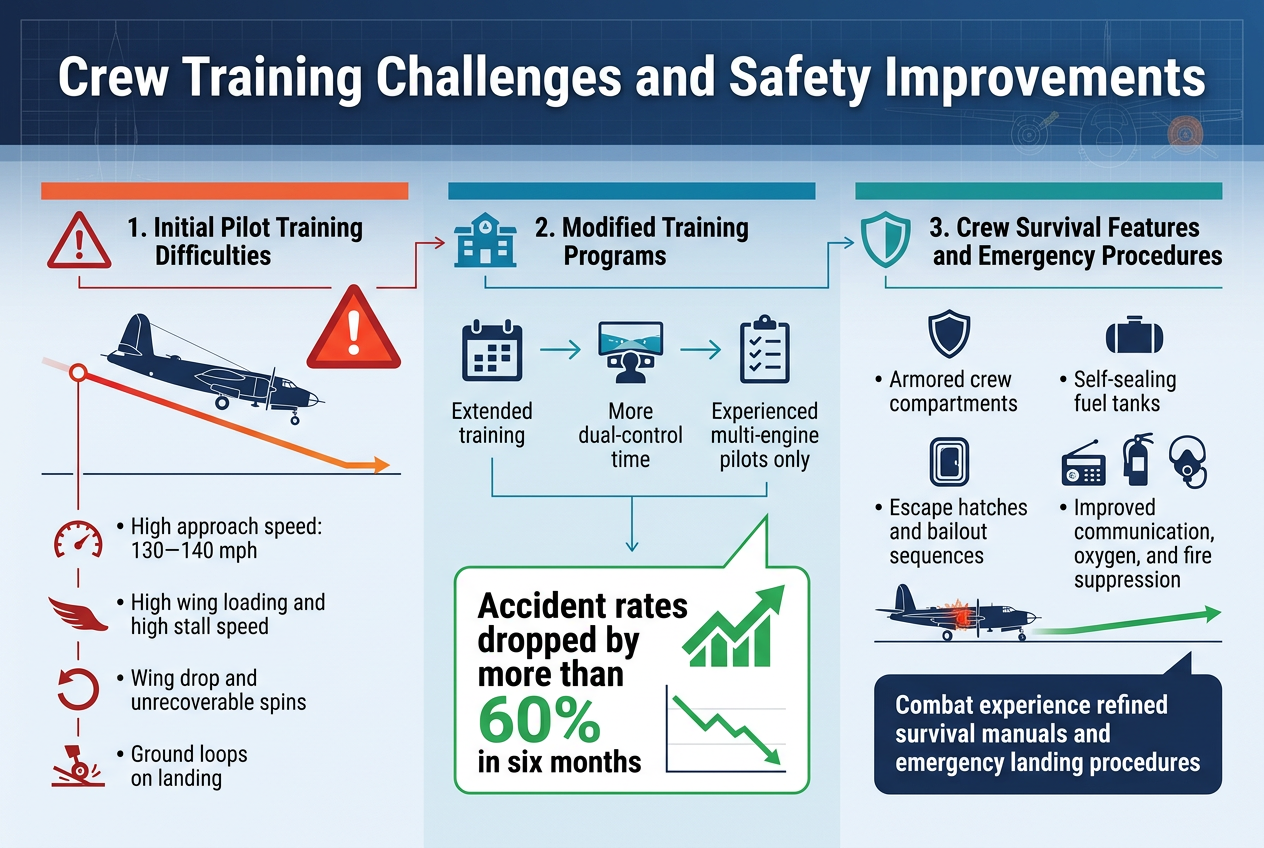
The B-26 Marauder quickly earned a reputation as an unforgiving aircraft that demanded exceptional skill from its pilots. Early training accidents plagued the program, with many inexperienced aviators struggling to master the aircraft’s high wing loading and unusually fast approach speeds. The Marauder required landing approaches at 130-140 mph, significantly faster than most contemporary aircraft, leaving little margin for error.
Many training fatalities occurred during the critical phases of takeoff and landing. The aircraft’s short, stubby wings produced high stall speeds, and pilots accustomed to more forgiving aircraft found themselves behind the power curve before they realized it. The Marauder’s tendency to drop a wing during stalls caught many pilots off guard, often resulting in unrecoverable spins at low altitude.
Ground loops during landing were common because of the aircraft’s narrow landing-gear stance and forward center of gravity. Pilots had to maintain precise speed control throughout the approach; flying too slowly led to dangerous sink rates, while excessive speed made stopping within reasonable runway distances nearly impossible. Together, these factors led to a troubling accident rate that threatened the entire program.
Modified training programs that reduced accident rates significantly
Recognition of the training crisis prompted a complete overhaul of B-26 Marauder pilot instruction programs. The Army Air Forces established specialized training schools that focused specifically on the Marauder’s unique handling characteristics. These programs extended training time and implemented a more gradual progression through increasingly complex maneuvers.
Instructors developed new techniques for teaching proper approach procedures, emphasizing consistent airspeed control and shallow descent angles. They introduced mandatory dual-control time requirements that far exceeded standard training protocols. Students repeatedly practiced emergency procedures, including single-engine approaches and forced landings, building muscle memory for critical situations.
Training aids made a substantial difference. Though primitive by modern standards, flight simulators let pilots practice dangerous scenarios safely. Ground school instruction expanded to include detailed systems knowledge and emergency checklists. Most importantly, Marauder training selected only experienced pilots with extensive multi-engine time, eliminating many candidates who lacked the fundamental skills needed for success.
These changes produced dramatic results. Accident rates dropped by more than 60% within six months of implementing the new training protocols.
Crew survival features and emergency procedures development.
The B-26 Marauder’s design incorporated several innovative safety features that proved crucial for crew survival. The aircraft’s robust construction included armored crew compartments and self-sealing fuel tanks that could withstand significant battle damage. Multiple escape hatches offered evacuation options from different crew positions, though the aircraft’s size and complexity made emergency egress challenging.
Emergency procedures evolved throughout the war based on combat experience and accident investigations. Crews developed standardized bailout sequences that maximized survival chances during catastrophic failures. The aircraft’s excellent single-engine performance meant any crew could return to base even after losing one powerplant, provided they followed proper procedures.
Fire suppression systems and improved oxygen equipment reduced risks during high-altitude missions. Better communication systems let crew members coordinate emergency actions more effectively. Emergency landing procedures were refined to leverage the Marauder’s robust landing gear and structural integrity, enabling successful crash landings that might otherwise have been fatal in less robust aircraft.
Combat units developed detailed survival manuals that covered everything from ditching procedures over water to emergency navigation techniques. These protocols saved countless lives and improved the B-26 Marauder’s safety record as the war progressed.
Legacy and Impact on Military Aviation
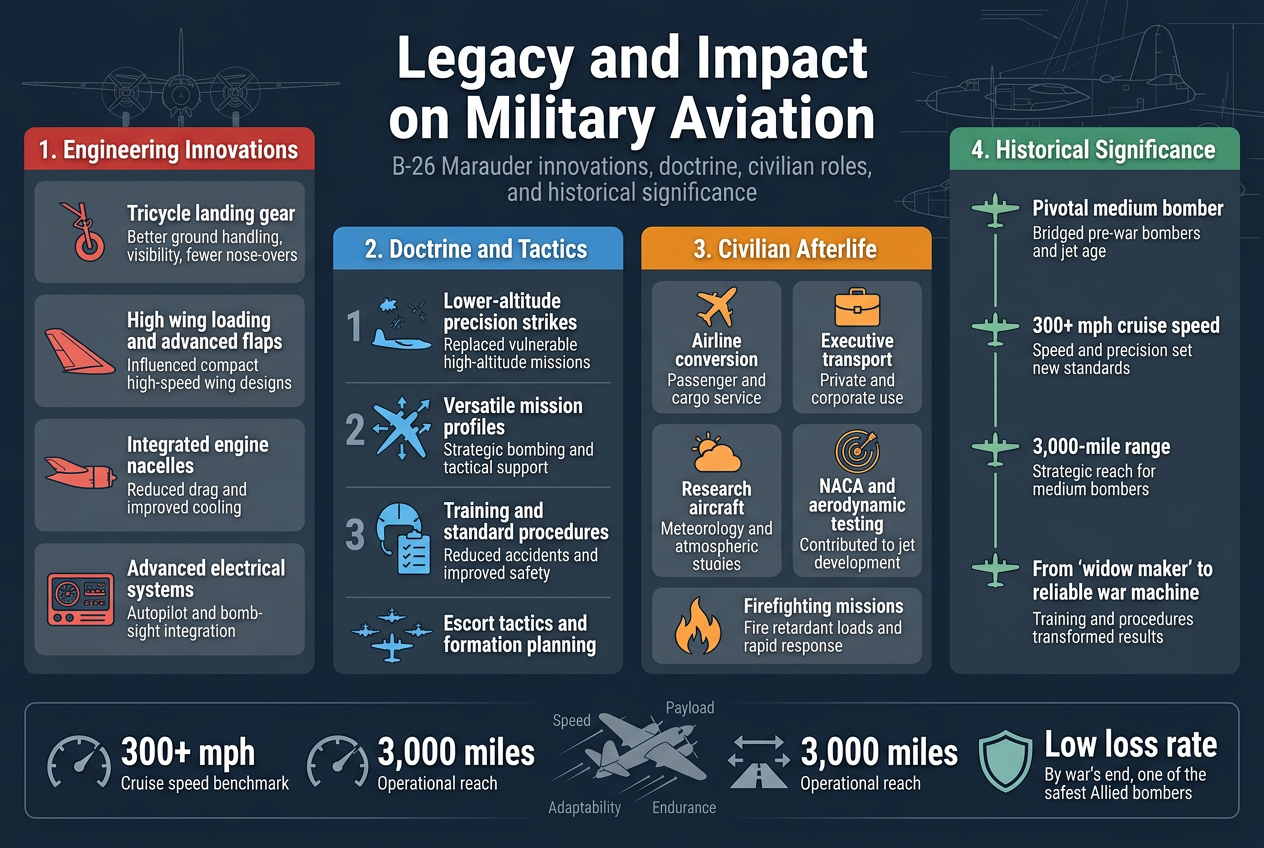
Technological innovations adopted by subsequent aircraft designs
The B-26 Marauder pioneered several engineering solutions that became standard features in future military aircraft. Its tricycle landing gear configuration, revolutionary at the time, proved so effective that virtually all subsequent medium and heavy bombers adopted this design. The gear improved ground handling, increased pilot visibility during taxiing, and reduced the risk of nose-over accidents that plagued tail-dragger aircraft.
Despite its initial controversy, the B-26 Marauder’s wing design significantly influenced post-war aircraft development. Its high wing loading and sophisticated flap systems demonstrated that aircraft could achieve excellent performance with compact, efficient wing designs. This principle directly influenced jets like the B-47 Stratojet, which featured similar high-speed wing characteristics.
The Marauder’s engine nacelle integration set new standards for aerodynamic efficiency. Seamlessly blending powerplants into the wing structure reduced drag and improved cooling, concepts aerospace engineers refined in later designs. The aircraft’s electrical systems, including its advanced autopilot and bomb-sight integration, laid the groundwork for the sophisticated avionics packages that would define Cold War-era bombers.
Marauder operations influenced the evolution of strategic bombing doctrine
B-26 Marauder operations fundamentally reshaped medium-altitude bombing tactics and doctrine. Early high-altitude missions proved vulnerable to fighter interception, forcing tactical adjustments that emphasized lower-altitude precision strikes. This evolution directly informed post-war strategic thinking about penetrating sophisticated air defense systems.
The aircraft’s successful transition from high-altitude strategic bombing to medium-altitude tactical support demonstrated the versatility modern warfare demands. Commanders learned that effective bombing campaigns needed adaptable platforms capable of multiple mission profiles. This flexibility became a cornerstone of post-war bomber design requirements.
Combat experience with the B-26 Marauder highlighted the critical importance of crew training and standardized procedures. The initial high accident rate, followed by dramatic safety improvements through enhanced training protocols, established new standards for aircrew preparation. These lessons directly influenced how the Air Force approached training for complex aircraft like the B-47 and B-52.
The Marauder’s operational history also revealed the evolving relationship between bombers and fighter escorts. Mission planners developed new formation tactics and escort procedures that maximized bomber survivability while maintaining strike effectiveness. These tactical innovations became foundational elements of Cold War strategic bombing doctrine.
Post-war civilian applications and surplus aircraft utilization
After 1945, hundreds of surplus Marauders found new life in civilian roles. Airlines converted many aircraft for passenger and cargo service, particularly in Latin America and Europe, where their robust construction and reliable performance proved valuable for commercial operations. The aircraft’s spacious bomb bay made it ideal for freight hauling, while its speed and range suited regional passenger routes.
Executive transport represented another significant civilian application. Wealthy individuals and corporations acquired converted Marauders for private use, appreciating their comfort, speed, and prestige. The aircraft’s military heritage and distinctive appearance made it a popular choice for air show demonstrations and warbird collectors.
Research organizations embraced the B-26 Marauder’s capabilities for scientific missions. Weather services used modified aircraft for meteorological research, while universities employed them for atmospheric studies and experimental programs. NASA’s predecessor, NACA, operated several Marauders for aerodynamic research projects that contributed to jet aircraft development.
Many aircraft served firefighting roles, particularly in the American West. Their large internal volume allowed substantial fire-retardant loads, while their speed enabled rapid response to remote fire locations. Some Marauders continued flying firefighting missions well into the 1960s, a testament to their enduring utility and structural integrity.
Historical significance in advancing medium bomber capabilities
The B-26 Marauder represents a pivotal moment in military aviation, bridging the gap between pre-war biplane bombers and jet-age strategic aircraft. Its development marked the military’s first serious attempt to create a high-performance medium bomber optimized for speed and payload rather than traditional stability and ease of handling.
The Marauder’s performance standards influenced an entire generation of military aircraft. Its 300+ mph cruise speed and 3,000-mile range set new benchmarks that subsequent designs had to match or exceed. The aircraft demonstrated that medium bombers could achieve strategic impact through speed and precision rather than massive bomb loads alone.
The Marauder’s troubled early service history became a crucial learning experience for military aviation. The initial design’s demanding flight characteristics forced the development of new training methods, maintenance procedures, and operational protocols. These hard-won lessons prevented similar problems with later high-performance aircraft and established safety standards that saved countless lives.
International operators of the Marauder, including Britain’s RAF and Free French forces, provided valuable feedback that influenced Allied aircraft development. Their combat experience validated design concepts while highlighting areas for improvement, creating an international knowledge base that advanced bomber technology worldwide.
The aircraft’s wartime service record ultimately vindicated its controversial design. Despite initial difficulties, the B-26 Marauder achieved one of the lowest loss rates among Allied bombers by war’s end. This transformation from “widow maker” to reliable war machine demonstrated the importance of proper training and operational procedures in maximizing aircraft effectiveness.
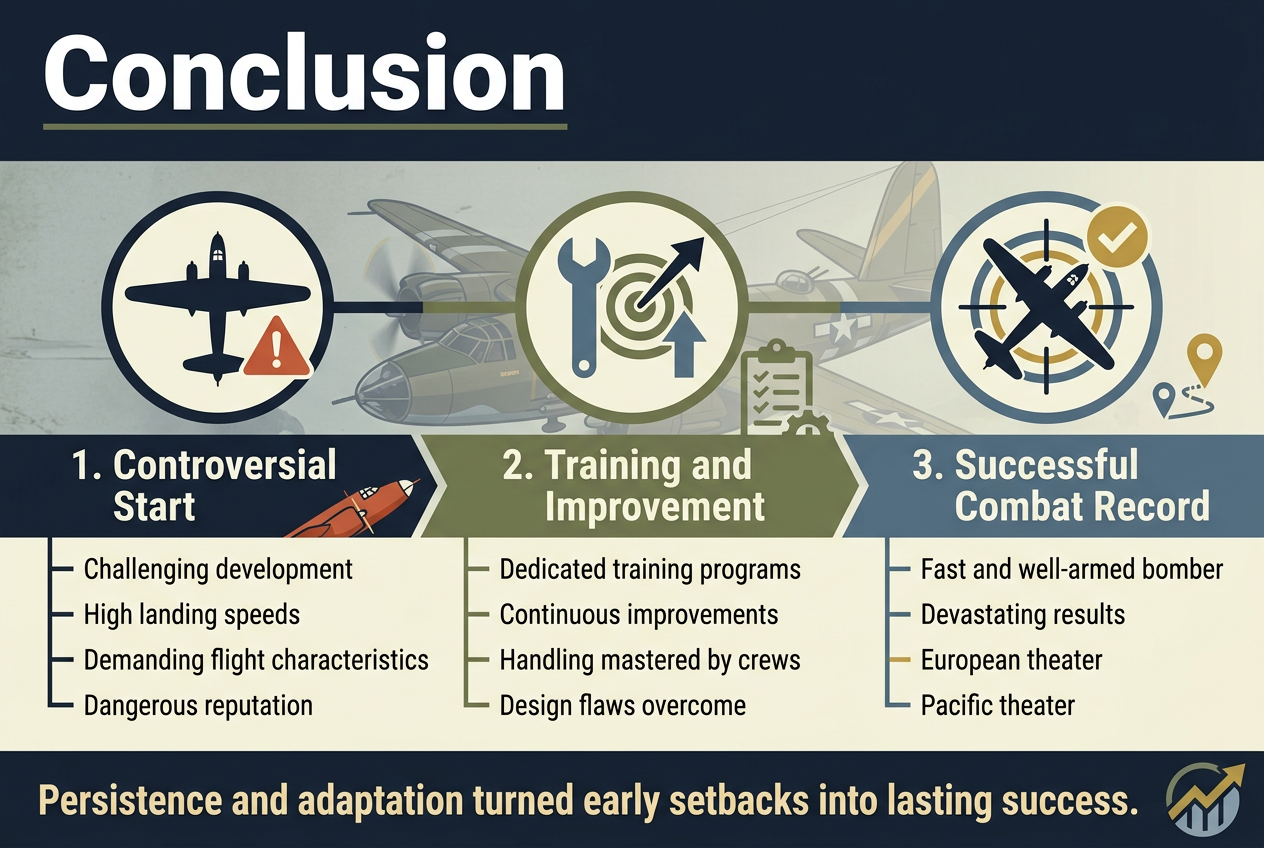
The Martin B-26 Marauder stands as one of World War II’s most controversial yet ultimately successful medium bombers. From its challenging development to its impressive combat record, the aircraft showed how dedicated training and continuous improvements could overcome initial design flaws. The Marauder’s high landing speeds and demanding flight characteristics initially earned it a dangerous reputation. Still, crews who mastered its quirks discovered a fast, well-armed bomber capable of delivering devastating results against enemy targets.
The B-26 Marauder’s transformation from a problematic newcomer to a reliable workhorse offers valuable lessons about persistence and adaptation in military aviation. The Marauder’s eventual success in the European and Pacific theaters proved that even aircraft with difficult handling could become effective weapons with proper training and tactical adjustments. Today, the B-26’s legacy reminds us that innovation often brings growing pains, but a commitment to improvement can turn early setbacks into lasting achievements that shape the future of aviation technology.