F-80 Shooting Star
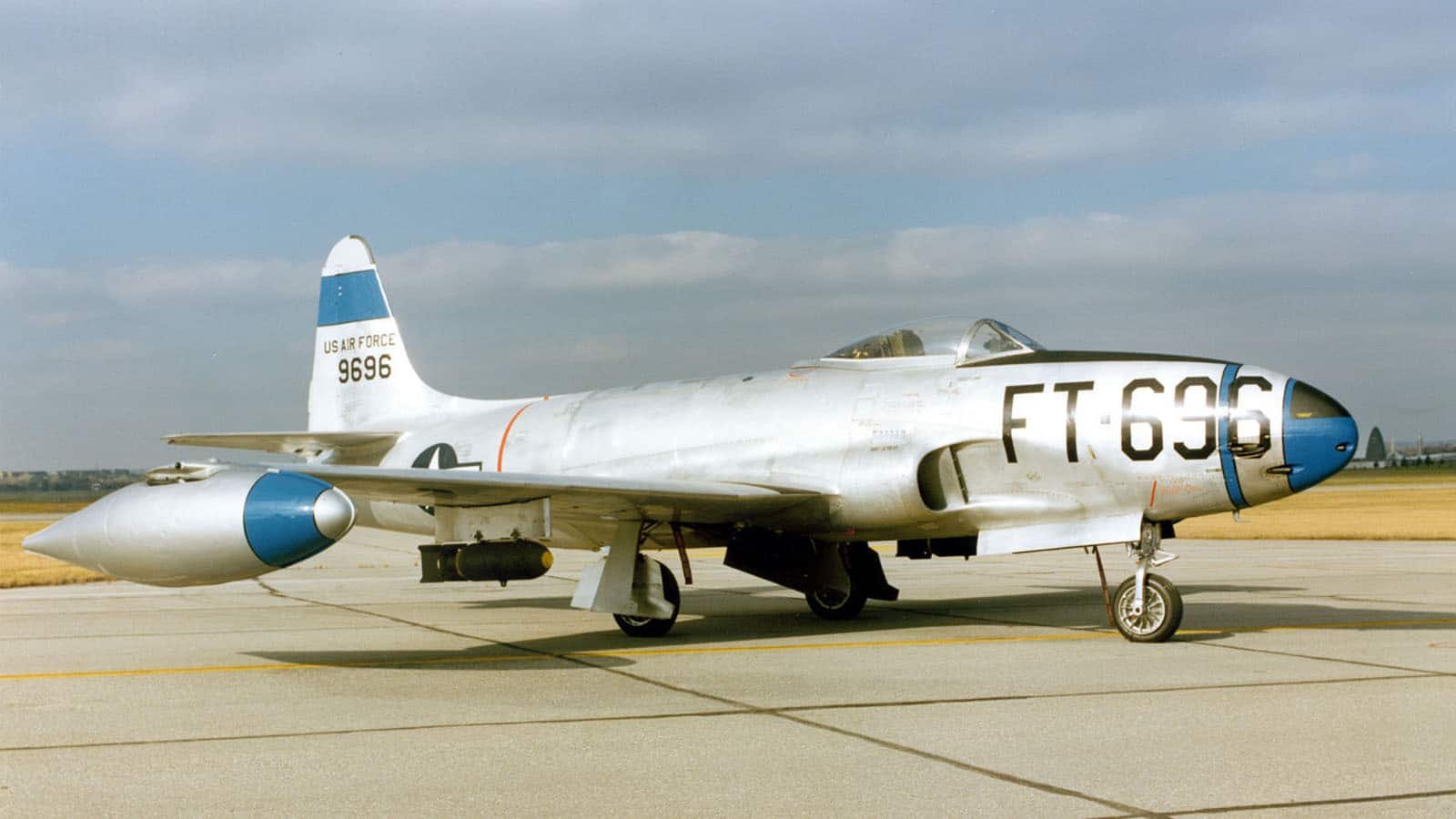
The F-80 Shooting Star is a historic American jet fighter aircraft that played a significant role in the early years of the United States Air Force (USAF) and in the transition from propeller-driven combat aircraft to the jet age.
Originally developed by Lockheed during World War II under the designation P-80, it was designed by a team led by the renowned engineer Clarence “Kelly” Johnson, who later became famous for Lockheed’s advanced aircraft development programs.
Background Information:
During its development, the F-80 Shooting Star marked a significant advancement in military aviation technology.
Although the Shooting Star arrived too late to see major combat service in World War II, it quickly became an important symbol of American aviation progress.
The F-80 was the first operational jet fighter used by the USAF and one of the first successful jet fighters produced in the United States. Its introduction gave American pilots valuable experience with the speed, handling, and maintenance requirements of jet-powered aircraft.
Compared with the piston-engine fighters that had dominated the skies during World War II, the F-80 offered much higher speeds and represented a major technological leap forward. It helped establish the foundation for later generations of American jet fighters.
The aircraft also saw important service during the Korean War, where it was used in fighter, ground-attack, and reconnaissance roles.
While it was eventually outclassed in air-to-air combat by more advanced swept-wing jets such as the Soviet-built MiG-15, the F-80 remained useful as a reliable strike aircraft.
Its legacy continued through the T-33 Shooting Star, a two-seat trainer version that became one of the most widely used jet training aircraft in the world.
As a result, the F-80 Shooting Star holds an important place in aviation history as a pioneering jet fighter that helped shape the future of the United States Air Force.
Development and Service Introduction:
- The F-80 Shooting Star was developed by the Lockheed Aircraft Corporation in the late 1940s, following the end of World War II.
- It was designed to meet the growing need for jet-powered fighters to combat the German Me 262 during the war.
- The prototype of the F-80, called the XP-80, made its maiden flight in January 1944.
- The aircraft entered service with the USAF in 1945 and was deployed during the later stages of World War II, though it did not see combat.
Design and Features:
- The F-80 was a single-seat, single-engine aircraft with a straight-wing configuration.
- It featured tricycle landing gear, a departure from the traditional tail-dragger landing gear used in most aircraft at the time.
- The aircraft was powered by a General Electric J33 turbojet engine, which provided a top speed of nearly 600 mph (965 km/h).
- It was armed with six .50 caliber Browning machine guns and could carry up to 2,000 pounds (907 kg) of bombs or rockets.
Operational History of the F-80 Shooting Star:
- The F-80 Shooting Star served with distinction during the Korean War, where it was primarily used for ground-attack missions.
- It provided close air support to ground troops and conducted various interdiction missions, targeting enemy supply lines and infrastructure.
- The F-80 faced initial challenges in air-to-air combat due to its limited maneuverability compared to Soviet MiG-15 fighter jets. However, the USAF made modifications to improve its performance.
- Overall, the F-80 scored several aerial victories and played a crucial role in the early stages of the Korean War.
Countries That Used the F-80
Several countries purchased or acquired the F-80 Shooting Star from the United States through military assistance programs. Some of the countries that operated the F-80 include:
Italy: The Italian Air Force received many F-80Cs and F-80Ds used in the 1950s.
Belgium: Belgium acquired F-80Cs in the late 1940s and served with the Belgian Air Force until the early 1950s.
Netherlands: The Royal Netherlands Air Force operated F-80Cs and F-80Ds from the late 1940s until the early 1950s.
Turkey: Turkey received F-80Cs in the late 1940s and used them extensively in the Korean War. They operated the aircraft until the early 1960s.
Sweden: The Swedish Air Force used modified F-80Cs, known as RF-80Cs, for aerial reconnaissance from the late 1940s to the mid-1950s.
Venezuela: Venezuela acquired F-80Cs in the early 1950s and used them until the 1970s.
These are just a few examples of countries that used the F-80 Shooting Star, but there were others.
Italy: The Italian Air Force received many F-80Cs and F-80Ds used in the 1950s.
Belgium: Belgium acquired F-80Cs in the late 1940s and served with the Belgian Air Force until the early 1950s.
Netherlands: The Royal Netherlands Air Force operated F-80Cs and F-80Ds from the late 1940s until the early 1950s.
Turkey: Turkey received F-80Cs in the late 1940s and used them extensively in the Korean War. They operated the aircraft until the early 1960s.
Sweden: The Swedish Air Force used modified F-80Cs, known as RF-80Cs, for aerial reconnaissance from the late 1940s to the mid-1950s.
Venezuela: Venezuela acquired F-80Cs in the early 1950s and used them until the 1970s.
These are just a few examples of countries that used the F-80 Shooting Star, but there were others.
Legacy:
- The F-80 Shooting Star marked a significant milestone in the development of jet-powered aircraft for the USAF.
- It paved the way for subsequent jet-powered fighters and helped transition the USAF from propeller-driven to jet-powered aviation.
- The F-80 also served as the basis for various other aircraft variants, including the RF-80 reconnaissance version and the T-33 trainer.
- Although more advanced fighters eventually replaced it, the F-80 Shooting Star remains important in aviation history.
Frequently Asked Questions
Is the F-80 still flying?
The F-80 Shooting Star is no longer in active military service. It was phased out of service by most air forces in the 1970s. While a few privately owned F-80s still exist, they are primarily preserved in museums or used for static display purposes.
How fast was the F-80?
The F-80, also known as the Lockheed P-80 Shooting Star, had a top speed of approximately 600 miles per hour (965 kilometers per hour) or Mach 0.78. However, later variants of the F-80, such as the F-80C and F-80 Shooting Star (T-33), had a slightly higher top speed of around 600-650 miles per hour (965-1,046 kilometers per hour).
How many F-80 aircraft were built?
A total of 1,715 F-80 aircraft were built.
What aircraft replaced the F-80?
The aircraft that replaced the F-80 was the North American F-86 Sabre.
Conclusion
In summary, the F-80 Shooting Star was the first operational jet fighter used by the USAF. It served with distinction during the Korean War.
Furthermore, it played a crucial role in the early development of jet-powered aviation. The F-80 set the stage for the future of American military aircraft design.