F-86 Sabre
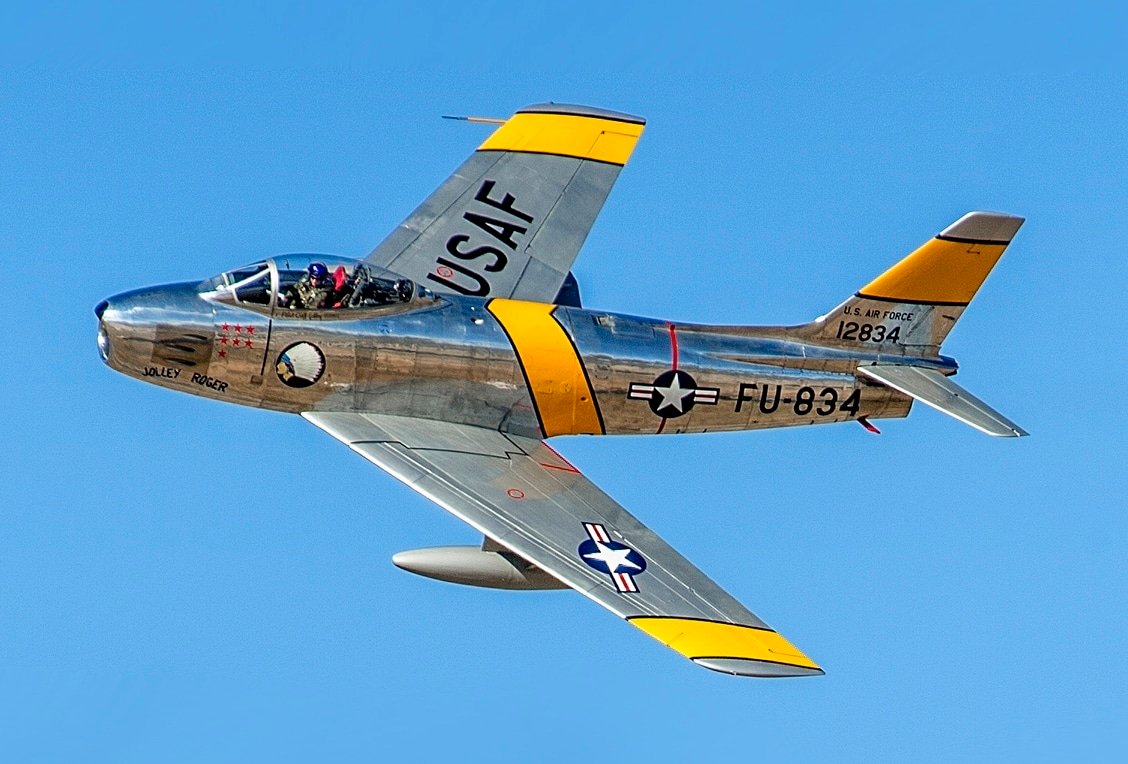
The F-86 Sabre, also known as the North American F-86 Sabre, was a transonic jet fighter aircraft developed by North American Aviation. It was used primarily by the United States Air Force (USAF) during the early years of the Cold War, most famously in the Korean War. Introduced in the late 1940s, the Sabre represented a major step forward in fighter design, combining swept wings, a powerful jet engine, and excellent high-speed handling.
These features allowed it to approach transonic speeds. This made it one of the most advanced fighter aircraft of its time. The F-86 became especially well known for its role in aerial combat over Korea, where it was frequently matched against the Soviet-designed MiG-15. These encounters, particularly in an area known as “MiG Alley” near the Yalu River, became some of the most intense jet-versus-jet battles in aviation history.
Although the MiG-15 had certain advantages in climb rate and altitude performance, the F-86 Sabre was praised for its superior maneuverability, stability, gunsight technology, and overall pilot-friendly design.
Skilled USAF pilots used these strengths effectively. This helped the Sabre earn a strong reputation as a capable and reliable fighter. It became one of the most widely produced jet fighters of the post-World War II era. The F-86 was built in several variants and served with numerous air forces around the world.
Beyond its combat service, it helped shape the future of jet fighter development. The F-86 contributed to the transition from propeller-driven aircraft to modern jet-powered military aviation. Its success during the Korean War secured its place as one of the most iconic fighter aircraft of the 20th century.
Development
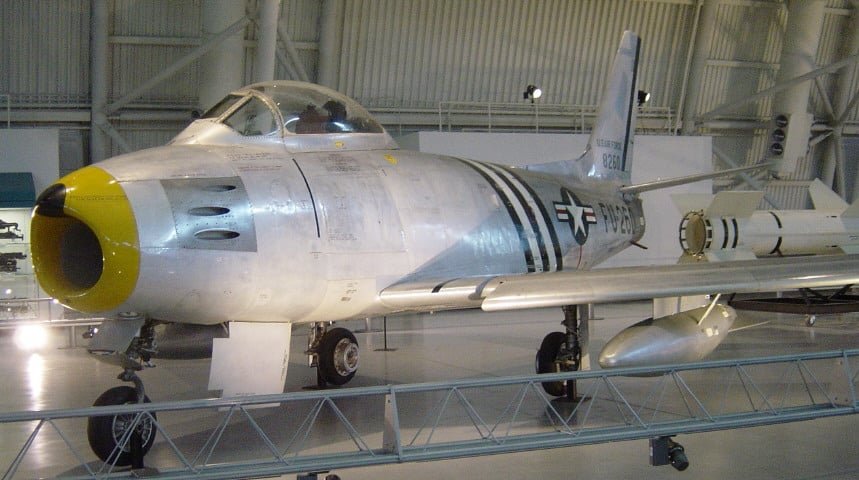
Developed by North American Aviation, the F-86 Sabre was introduced in 1949 and became operational the following year. It was designed to counter enemy MiG-15 aircraft in the Korean War theatre. The Sabre was known for its exceptional performance, speed, and maneuverability, making it a formidable opponent in air-to-air combat.
Armaments
The F-86 Sabre had a swept-wing design and was powered by a single jet engine. It featured six .50 caliber (12.7mm) machine guns mounted in the nose and provisions for carrying additional external ordnance such as rockets, bombs, and fuel tanks. In addition to its air superiority role, the Sabre was utilized for ground attack missions, reconnaissance, and as a fighter-bomber.
F-86 sabre in Combat
The F-86 Sabre achieved significant success in combat and earned a favorable reputation as one of the most capable jet fighters of the early Cold War era. Introduced at a time when air combat was rapidly shifting from propeller-driven aircraft to high-speed jets, the Sabre combined a swept-wing design, strong maneuverability, and reliable handling at high speeds.
These qualities made it especially effective in dogfights. A pilot’s ability to turn, dive, climb, and maintain control under pressure could determine the outcome of an engagement.
During the Korean War, the F-86 was credited with destroying many enemy aircraft, particularly in the air battles over northwestern Korea, often known as “MiG Alley.” Its primary adversary was the Soviet-designed MiG-15, a fast and heavily armed jet fighter that posed a serious threat to United Nations aircraft.
Although the MiG-15 had advantages in certain areas, such as climb rate and high-altitude performance, the Sabre offered excellent control, visibility, and stability. This gave skilled pilots important advantages in close combat.
The Sabre’s performance was enhanced by features such as responsive flight controls and effective gunsight technology. These helped pilots aim more accurately during high-speed engagements. Armed typically with six .50-caliber machine guns, the F-86 relied on precision, pilot training, and tactical discipline rather than sheer firepower alone.
American and allied pilots used teamwork, experience, and well-developed tactics to counter the MiG-15’s strengths and exploit its weaknesses.
Conclusion
After the Korean War, the F-86 Sabre did not fade quickly from military service. Instead, it continued to serve with numerous air forces around the world for several decades. This proved that its value extended far beyond its famous role in the skies over Korea.
Many nations adopted the Sabre because it combined speed, maneuverability, solid firepower, and dependable engineering. This made it highly effective for both air combat and training duties. Variants built in the United States, Canada, Australia, and other countries helped spread the aircraft’s influence even further, allowing it to remain useful as jet technology continued to advance.
The F-86 saw service with air forces in Europe, Asia, the Middle East, and Latin America. It was used in a variety of military operations and regional conflicts. In some cases, it served as a front-line fighter; in others, it was later adapted for ground-attack missions or used to train pilots transitioning into the jet age.
Notably, Sabres were flown by Pakistan during the Indo-Pakistani conflicts, where the aircraft gained additional combat recognition. Other operators valued the Sabre for its ruggedness, ease of maintenance, and forgiving flight characteristics.
Its long service life, strong combat record, and reputation for reliability helped secure the F-86 Sabre’s place as one of the classic fighter aircraft of the twentieth century. More than just a successful Korean War jet, it became a symbol of early jet-age aviation and an influential design that shaped fighter development for years to come.