No products in the cart.






This website uses cookies to improve your experience. We'll assume you're ok with this, but you can opt-out if you wish. Read More
The P-43 Lancer, developed during World War II, may not have been the most effective fighter aircraft of its time, but it certainly made a mark with its exceptional high-altitude capabilities. This aircraft, designed by the Bell Aircraft Corporation, was initially meant to improve upon its predecessor, the P-39 Airacobra. While it did not meet expectations regarding overall performance and combat effectiveness, the P-43 Lancer stood out for its ability to operate at high altitudes, making it a valuable asset in certain situations.
One key feature that set the P-43 Lancer apart was its turbo-supercharged Allison V-1710 engine, which allowed the aircraft to reach higher altitudes than many of its contemporaries. This capability was particularly valuable in aerial combat scenarios where altitude could provide a strategic advantage. Pilots flying the P-43 Lancer could use its high-altitude performance to outmaneuver opponents or to evade enemy fire, showcasing the aircraft’s unique strengths and capabilities.
Despite its limitations in other areas, the P-43 Lancer’s high-altitude prowess earned it a reputation for being a reliable aircraft in certain combat situations. Pilots who flew this aircraft often praised its altitude handling and ability to perform well in challenging conditions. While it may not have been the most glamorous or successful fighter aircraft of its time, the P-43 Lancer’s unique abilities made it a noteworthy addition to the Allied forces during World War II.
In conclusion, although the P-43 Lancer may not have been a standout aircraft in terms of overall performance, its exceptional high-altitude capabilities set it apart from many of its contemporaries. With its turbo-supercharged engine and specialized design, this aircraft offered pilots a valuable advantage in aerial combat situations where altitude could make all the difference. While its success may have been limited in some regards, the P-43 Lancer remains a fascinating piece of aviation history, showcasing the innovation and adaptability of aircraft designers during World War II.
Republic Aviation built the P-43 Lancer, a collaborative effort by a team of engineers and designers that resulted in a versatile aircraft. The project aimed to create an advanced fighter plane that could meet the demanding requirements of the United States Army Air Corps.

One of the key features of the P-43 Lancer was its streamlined and aerodynamic fuselage. This design allowed the aircraft to achieve high speeds and excellent maneuverability, making it an effective interceptor. However, it lacked armor and self-sealing fuel tanks, and production was limited. The P-47 was seen as a more promising aircraft. The P-43 was used mostly for training; some were shipped to China.
Engineered for optimal performance, the P-43 Lancer was equipped with a powerful Pratt & Whitney radial engine and an arsenal of advanced weaponry. The heart of the aircraft, the R-2830 engine, was a 14-cylinder, twin-row radial engine that delivered an impressive 1400 horsepower. This engine provided the P-43 Lancer with exceptional speed and agility, giving it good high-altitude performance.
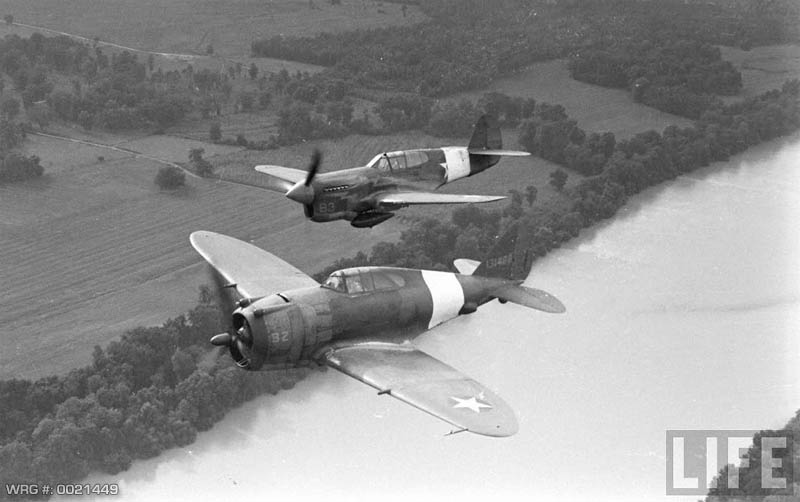
Equipped with its powerful engine and advanced weaponry, the P-43 Lancer demonstrated impressive high-altitude interception capabilities. This fighter aircraft was specifically designed to intercept enemy aircraft at high altitudes.
Additionally, the P-43 Lancer boasted a robust oxygen supply system, which was crucial for high-altitude operations. The system ensured the pilot had a continuous and adequate oxygen supply, enabling them to function optimally at higher altitudes. This feature allowed the P-43 Lancer to operate above many other aircraft of its time.
The P-43 Lancer played a minor role in World War II as it was considered unfit for combat. However, it was successful in high-altitude reconnaissance.
Around 272 P-43 Lancers were manufactured.
The lack of a self-healing fuel tank and armor made it easy to shoot down.
This aircraft saw limited action.
In conclusion, the P-43 Lancer did see limited combat action during World War II, primarily with the Chinese Air Force. While it was not as widely utilized as other fighter aircraft of the time, the Lancer played a role in defending Chinese airspace against Japanese aggression. Despite its initial setbacks and the eventual transition to other, more advanced aircraft, the P-43 Lancer’s contribution to the war effort should not be overlooked. Its combat experience provided valuable insights for future aircraft development, ultimately paving the way for more successful fighter planes in the years to come. The P-43 Lancer was not a significant aircraft during World War II. Its main contributions were as a trainer and high altitude reconnaissance.