
P-26 Peashooter: A Vintage Marvel
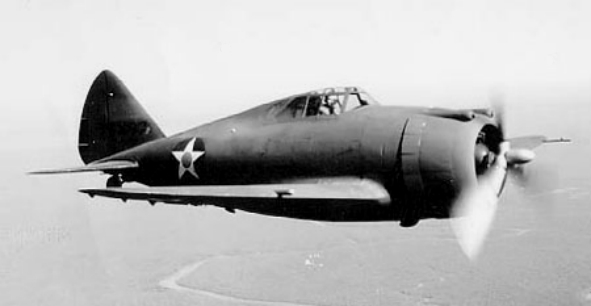
The P-26 Peashooter was a single-seat, all-metal monoplane fighter aircraft used by the United States Army Air Corps (USAAC) during the late 1930s. It was developed by the Boeing Company and introduced as the USAAC’s first all-metal fighter.
Other countries also used the P-26 Peashooter. Several P-26 aircraft were exported to China, where the Chinese Air Force used them. The planes were employed in combat against Japanese forces during the Second Sino-Japanese War, which started in 1937. Additionally, some P-26s were sold to the Philippines, Guatemala, and Panama, where they served in their respective air forces.
Origins of the P-26
The P-26 Peashooter originated in the Model 248, a design that Boeing produced in response to a USAAC requirement for a new pursuit aircraft in the mid-1930s. The USAAC sought a modern replacement for its biplane fighters, and the Boeing P26 Peashooter was the result of Boeing’s efforts.
Notable Features
The aircraft had several notable features for its time. It was also armed with a combination of machine guns and bombs. Initially, the P-26 had two .30 caliber machine guns synchronized to fire through the propeller arc, but later versions were equipped with two .50 caliber machine guns.
The P-26 Peashooter had a fixed landing gear, a common design feature of that era. Its wings were mounted mid-fuselage and were of a low-wing monoplane configuration. The aircraft was powered by a Pratt & Whitney R-1340-33 engine, delivering around 600 horsepower and achieving a maximum speed of approximately 235 mph (378 km/h). It had a range of about 360 miles (579 km) and a service ceiling of 27,400 feet (8,352 m).
Used in Combat
The Peashooter saw combat during the early stages of World War II, primarily during the Battle of Bataan in the Philippines and the defense of the Panama Canal Zone. However, by the outbreak of the war, the P-26 was already considered outdated compared to more modern fighters, such as the British Spitfire and the German Messerschmitt Bf 109.
Frequently Asked Questions
Are there any P-26 Peashooter aircraft left?
There are a few P-26 Peashooter aircraft still in existence today. Most of them are on display in museums around the world. Some examples can be found at the National Museum of the United States Air Force in Ohio, the Pacific Aviation Museum in Hawaii, the National Museum of the United States Air Force in Texas, and the National Air and Space Museum in Washington, D.C. Additionally, there are a few privately owned P-26s that are still airworthy and occasionally participate in airshows and aviation events.
Was the P-26 Peashooter ever used in combat?
The P-26 Peashooter was used in combat. It was an American fighter aircraft that saw action during the early years of World War II. The Philippine Army Air Corps used it during the early stages of the Pacific War against Japanese forces, where it fought in the air battles of the Philippines.
How fast was the P-26?
The P-26 Peashooter, an American single-seat fighter aircraft, had a maximum speed of around 234 mph (377 km/h).
Did the P-26 ever shoot down an enemy aircraft?
Yes, the P-26 Peashooter, an American fighter aircraft introduced in the 1930s, did shoot down enemy aircraft. During the Spanish Civil War, which occurred from 1936 to 1939, the P-26 was operated by Republican forces and reportedly shot down several enemy aircraft, including Fiat CR.32s and Heinkel He 51s. However, it is important to note that the P-26 was an earlier generation fighter and became outdated when World War II began.
Did the P-26 have an enclosed cockpit?
No, the P-26 Peashooter did not have an enclosed cockpit. It had an open cockpit design, which was common for aircraft of that era, and the pilot was exposed to the elements during flight.
Was the P-26 used by used by other countries?
The P-26 was used by other countries besides the United States. The Chinese Air Force used it during the Second Sino-Japanese War. The Chinese received around 45 P-26 aircraft from 1936 to 1942 and played a significant role in air battles against Japanese forces. The P-26 was also exported to other countries, including Panama, Guatemala, and the Philippines. Some countries used the P-26 in their air forces during the 1930s and early 1940s.
Conclusion
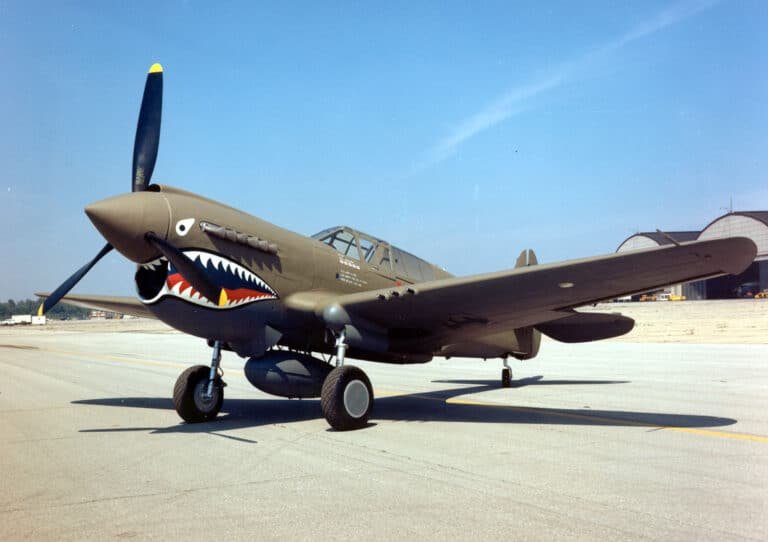
Despite its eventual obsolescence, the P-26 Peashooter played a significant role in the USAAC’s transition towards more advanced fighter aircraft. It served as an important stepping stone in the development of American fighter aircraft and paved the way for future successes, such as the P-40 Warhawk and the P-51 Mustang.